

Gun Safe Moving: When to Hire Pros vs. DIY

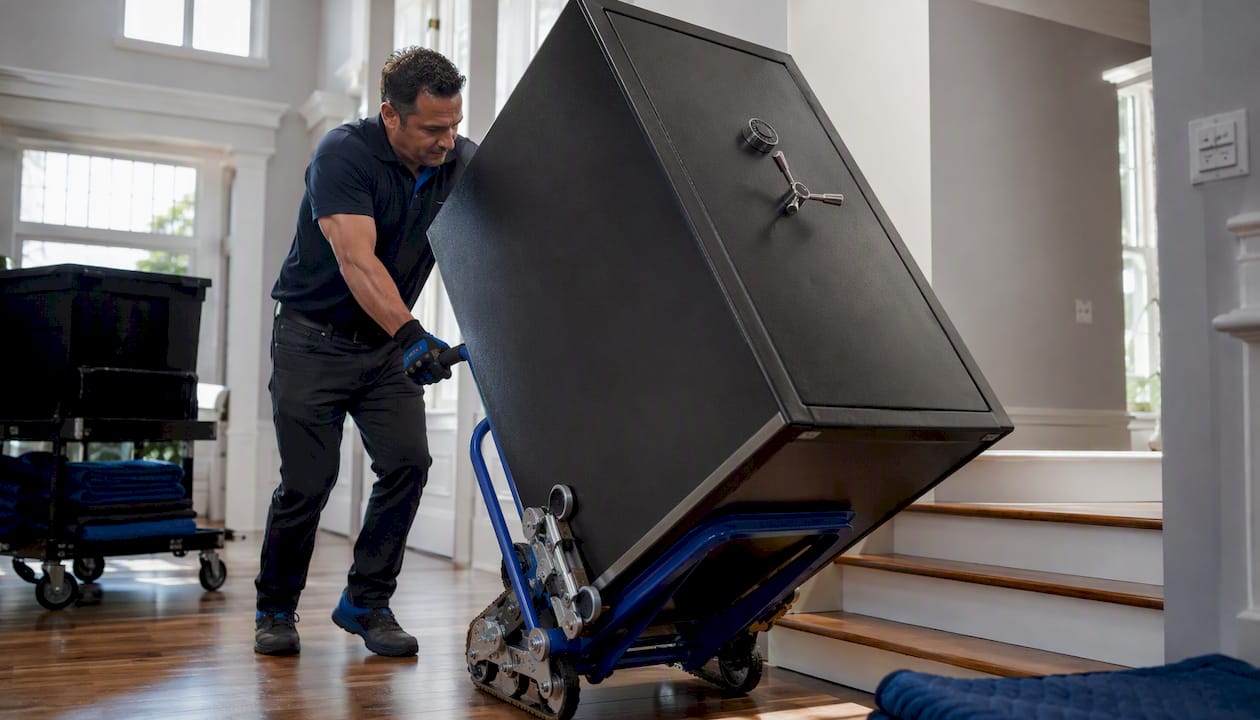
For most gun safe moves, hire a professional. If your safe weighs more than 300 pounds, sits on an upper floor, involves stairs, or is bolted to the floor, a trained crew with rated equipment is the right call — not a weekend project.
DIY is feasible only in a narrow set of circumstances:
The safe weighs under 300 lb and sits on a ground-level floor
The entire route is flat with no steps, tight turns, or narrow doorways
You have the correct equipment: a rated safe dolly, heavy-duty ratchet straps, moving blankets, and plywood floor protection
You have at least two physically capable people who know how to handle the load
The three risks that drive this recommendation are serious. Gun safes commonly weigh several hundred pounds, making them among the heaviest items in any home. That weight creates real injury risk, floor damage risk, and the possibility of damaging the safe’s locking mechanism if it tips or drops. Stairs multiply every one of those risks.
Pro Tip: Before you decide anything, weigh your safe or find the model’s spec sheet. The number changes everything about how this move should go.
Table of Contents
Should you hire a pro or move the safe yourself?
Weight is the clearest decision point. Moving guides consistently place gun safes at several hundred pounds, with commercial units sometimes weighing much more. At those numbers, a single misstep can injure a crew member or crack a floor joist.
Hire a professional when:
The safe weighs more than a few hundred pounds
Any part of the route involves stairs or a ramp with a grade steeper than 10 degrees
The safe is bolted to the floor or built into cabinetry
The destination is an upper floor (which also requires a floor-load check before move day)
Doorways or hallways leave less than two inches of clearance on each side
DIY may be reasonable when:
The safe is under a few hundred pounds, on a ground floor, and the route is completely flat
You can rent or own a rated dolly system with a documented weight capacity above the safe’s actual weight
You have two or more helpers and no time pressure that would rush the job
The cost trade-off matters here. A professional local move for a mid-size safe typically runs $250–$450. A back injury, a cracked floor, or a damaged locking mechanism can cost far more. For experienced moving professionals, the service fee is often the cheaper option once you account for equipment rental, vehicle costs, and risk.
How to move a gun safe yourself, step by step
Follow this sequence only if your safe meets the DIY criteria above. If anything changes mid-move, stop and call a mover.
Confirm the weight and measure every clearance. Pull the spec sheet for your safe model. Measure every doorway, hallway, and turn on the route. You need at least two inches of clearance on all sides to accommodate the dolly and your hands.
Empty the safe completely. Remove all firearms, ammunition, and shelving. Lock the door and verify it is fully latched before the safe moves an inch.
Protect the floors. Lay continuous sheets of hardboard or plywood along the entire route. Moving blankets alone are not enough for heavy loads.
Wrap the safe. Cover all exterior surfaces with moving blankets, then secure them with stretch wrap. This protects the finish and the locking mechanism from impact.
Position the dolly. For flat-surface moves, a split-dolly system raises the safe only about 1.5 inches and keeps it upright, which reduces tipping risk. Rated pairs can handle up to 1,600 lb on flat ground. Slide the dollies under opposite sides simultaneously.
Strap and ratchet. Run heavy-duty ratchet straps around the safe and through the dolly frame. Tighten until the safe does not shift when you apply lateral pressure.
Roll slowly and with spotters. One person guides from the front, one controls from the rear. Nobody stands directly behind or under the load. Keep hands and feet clear of the wheels.
Load the vehicle with a ramp. Use a rated loading ramp, not a makeshift board. Roll the safe up the ramp with the rear handler controlling descent speed. Secure with rated vehicle tie-downs before closing the door.
At the destination, reverse the process. Unload before unstrapping. Re-lay floor protection. Roll to the final position before removing the dolly.
Safety rule: If the safe shifts unexpectedly, do not try to catch it. Step clear and reassess. A shifted load is a signal to stop the DIY attempt and call a professional crew.
What changes when stairs, narrow halls, or bolted safes are involved
These situations are not merely harder versions of a standard move but are categorically different, and most require professional handling.
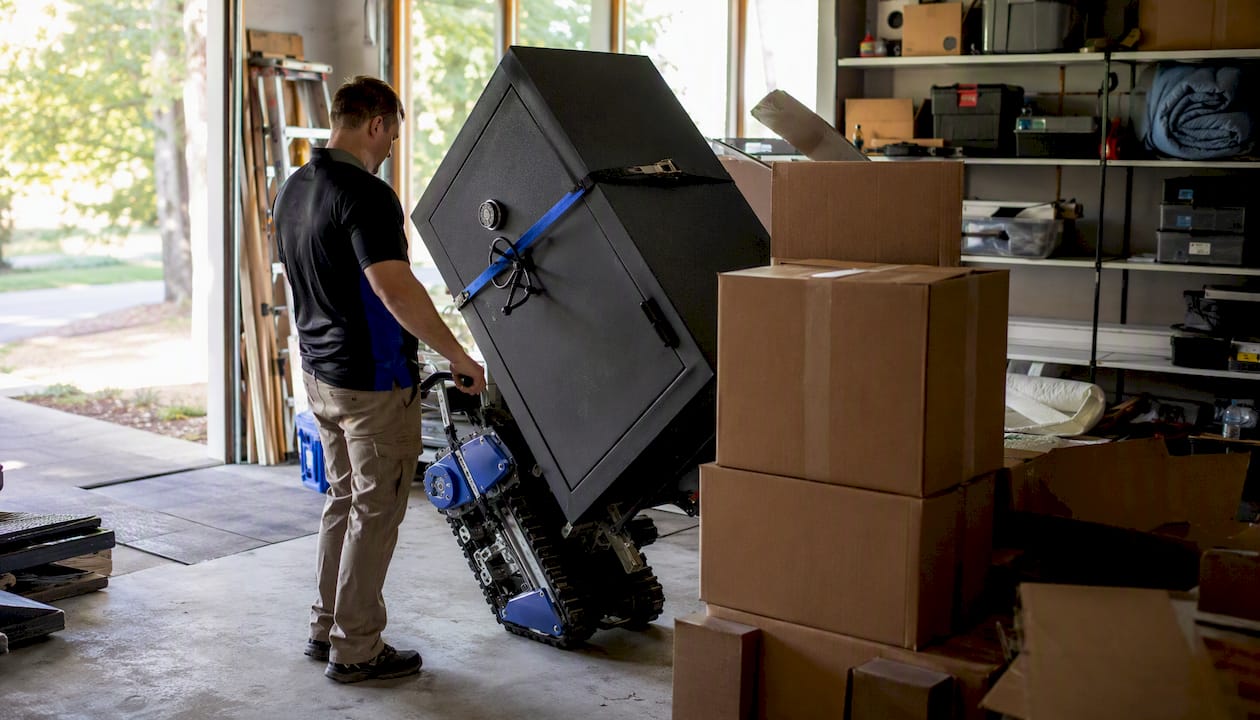
Stairs are the highest-risk scenario in any safe relocation. Stair-climbing dollies and harness systems are the minimum equipment required, and operating them correctly takes trained crew members who have done it before. A 500-pound safe on a staircase with an untrained team is a genuine danger to people and the structure of the home.
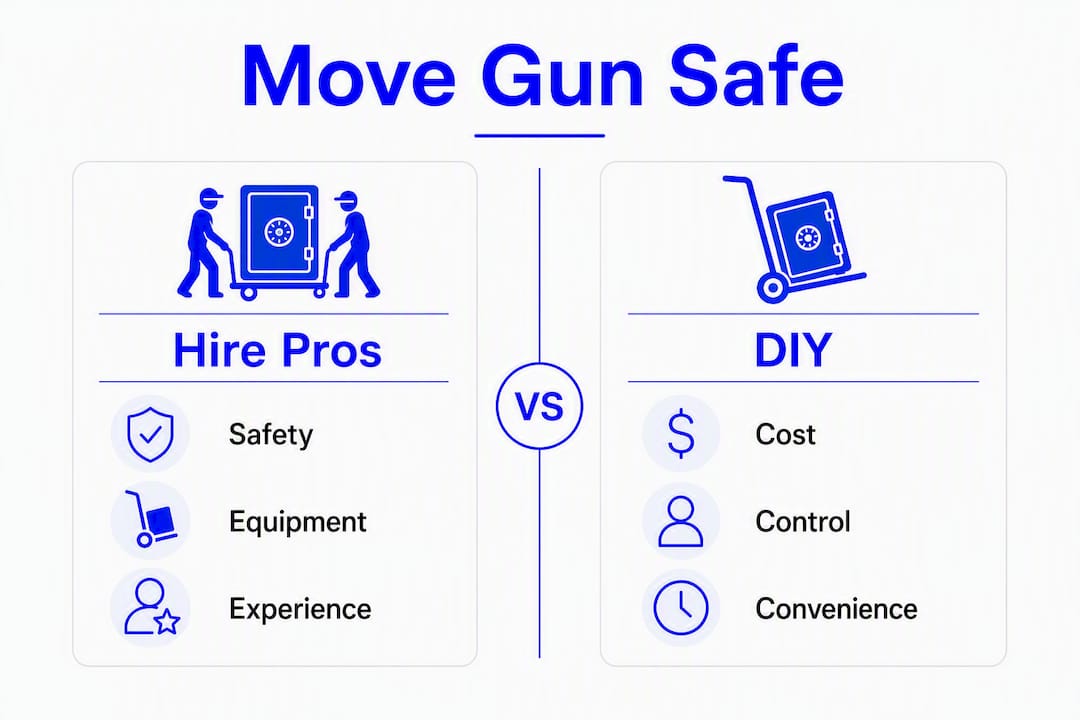
Narrow hallways create tipping hazards when the dolly’s footprint approaches the wall. The two-inch clearance rule applies to all sides simultaneously. If a doorframe forces the safe to tilt even slightly, control of the load becomes unpredictable.
Bolted and built-in safes require unbolting before the move, which sometimes means patching the floor or subfloor afterward. If the bolts are set in concrete, you may need a contractor involved before a moving crew can begin.
Oversized commercial safes above 2,000 pounds may require a forklift, crane rigging, or a municipal permit for the vehicle. This is firmly professional territory.
Upper-floor placement triggers a separate concern: floor-load capacity. A structural engineer or contractor should confirm the floor can support the safe’s weight before it arrives. Professionals often supply a written recommendation when they identify a concern.
Pro Tip: If you reach any point in a DIY move where you feel uncertain about control, stop. Set the safe down safely, secure it so it cannot roll, and call a mover. There is no cost-saving that justifies a tipping load.
Firearm transport rules and insurance you need to check first
Moving a gun safe does not automatically mean your firearms are legally transported. These are separate obligations.
Keep all firearms unloaded during transport. This applies whether you are moving across town or across the state.
Check your state’s transport laws before move day. Rules on how firearms must be stored in a vehicle vary by state and sometimes by municipality. Verify with your state’s attorney general office or a licensed firearms dealer.
Review your homeowner’s or renter’s insurance policy. Many policies cover contents during a move, but coverage limits and exclusions vary. Call your insurer and ask specifically about firearms and high-value items in transit.
If hiring a mover, collect these documents before signing anything: proof of general liability insurance, proof of worker’s compensation coverage, a written itemized estimate, and the mover’s damage claims process in writing.
Consider short-term transit coverage if your policy has gaps. Some insurers offer riders for high-value items during a move.
What does a gun safe move typically cost?
Cost depends on weight, distance, stairs, crew size, and required equipment. The table below reflects commonly cited ranges for local moves.
Safe size | Approximate weight | Typical local move cost |
Small home safe | Under 300 pounds | $150–$250 |
Mid-size gun safe | 300–800+ pounds | $250–$450 |
Large gun safe | 800+ pounds | $400–$750 |
Oversized/commercial | 2,000+ pounds | $600–$1,000+ |
Stairs, permits, or structural work add to these figures. A single-stop local move on flat ground typically completes in 1–3 hours, including truck loading, transit, and placement. Reinstallation (bolting, leveling, interior refit) adds time depending on the safe model.
Always request an itemized quote, not just a total. Flat-rate quotes are easier to budget; hourly quotes can climb if the move takes longer than estimated.
How to choose the right mover for a gun safe
Not every moving company has the equipment or experience for this job. Use this checklist when you contact movers.
Ask how many safes they have moved and request a reference from a comparable job.
Confirm they own stair-climbing dollies, rated straps, and a vehicle with a lift gate.
Request proof of general liability insurance and worker’s compensation before the move date.
Get a written, itemized estimate. Refuse any mover who will only quote verbally or insists on hourly billing without a site assessment.
Check Google reviews specifically for mentions of heavy or specialty moves.
Red flags to watch for:
Vague answers about equipment (“we have dollies” with no specs)
No written estimate or resistance to providing one
No proof of insurance when asked directly
Pressure to book immediately without a site visit for a large or complex move
A simple email to send movers: “I need to move a [weight] gun safe from [origin] to [destination], including [stairs/no stairs]. Can you confirm your equipment list, insurance coverage, and provide a written itemized estimate?” That one message filters out most unqualified crews quickly.
How Atlaskings handles gun safe moves
Atlaskings approaches every safe move with a documented, safety-first process built on the same principles that have supported 500+ successful moves since 2021.
In-home assessment: We review the route, measure clearances, and identify any structural concerns before quoting.
Itemized flat-rate pricing: You receive a written quote with no hidden costs, covering equipment, crew, and transit.
Rated equipment: Our crews use rated dollies and lift systems matched to the safe’s weight, plus heavy-duty straps and full floor protection.
Insured and licensed: We carry general liability insurance and worker’s compensation on every job.
Reinstallation included: After transport, we handle bolting, leveling, and interior refit so the safe is ready to use.
On move day, you can expect a crew that arrives prepared, communicates clearly, and follows a step-by-step process designed to protect your home, your safe, and everyone involved.
Key Takeaways
Hiring a professional mover is the right choice for any gun safe over 300 lb, any stair move, or any upper-floor placement — the cost of a professional move is almost always less than the cost of an injury or damaged safe.
Point | Details |
Weight drives the decision | Gun safes commonly weigh several hundred pounds; weights above that range generally warrant a professional crew. |
Stairs require specialist gear | Stair-climbing dollies and harness systems are the minimum; untrained DIY on stairs is high-risk. |
Measure clearance, not just width | You need at least two inches of margin on all sides to maintain control of the load. |
Verify insurance and firearm laws | Check your homeowner’s policy and state transport rules before move day, not after. |
Atlaskings offers flat-rate moves | Itemized pricing, rated equipment, and 500+ completed moves make Atlaskings a reliable choice for safe relocation. |
The part most people don’t think about until move day
The single most common surprise a crew encounters is a route that looked fine on paper but wasn’t. A doorframe that’s half an inch narrower than measured. A hallway that turns at an angle nobody walked with a tape measure. A floor that flexes under load in a way that wasn’t obvious until a 600-pound safe was rolling across it.
The prep work that actually saves time and prevents damage is unglamorous: walk the entire route with a tape measure twice, remove door trim temporarily if clearance is tight, and lay continuous plywood from the safe’s current position to the truck. Gaps in floor protection are where scratches happen. Gaps in route planning are where injuries happen.
Safety protocols and crew training matter, but the honest truth is that a well-prepared route makes the physical move straightforward. A poorly prepared one makes even a short move complicated.
Atlaskings makes gun safe moves straightforward
Moving a gun safe doesn’t have to be a stressful calculation of risk versus cost. Atlaskings offers in-home delivery and heavy-item transport with itemized flat-rate pricing, so you know exactly what you’re paying before the crew arrives. No hourly surprises, no vague estimates.

Our lift and transport services cover rated equipment, insured crew, floor protection, and reinstallation. Whether you’re moving a mid-size safe across town or placing a large unit in a new home, we handle the logistics from assessment to final bolt-down.
To schedule an on-site assessment or get a written quote, book your move online. We’ll confirm your route, your equipment needs, and your price before anything moves.
Useful sources
Moving to a new home? Relocate your safe properly — practical guidance on professional equipment, stair risks, and upper-floor placement
How to Move a Heavy Safe: 10 Tips to Keep You Safe — preparation steps, weight ranges, and representative cost data
How to Move a Gun Safe by Yourself — split-dolly system specs and flat-surface DIY guidance
For firearm transport rules, verify your state’s current statutes through your state attorney general’s website or a licensed firearms dealer. For insurance coverage during a move, contact your insurer directly and ask specifically about high-value items and transit coverage.
Recommended
Comments