

Long Distance Moving Company Prices: 2026 Guide


Long distance moving company prices are calculated based on shipment weight, distance, service level, and timing, with total all-in costs ranging from $5,000 to $15,000 for most households. That range reflects the full picture: base line-haul charges, fuel surcharges, accessorial fees, and valuation coverage. The industry term for this pricing model is “weight-and-distance tariff,” and it is regulated by the Federal Motor Carrier Safety Administration (FMCSA) for all interstate moves. Knowing how each component adds up puts you in control of your budget before a single box gets packed.
What components make up long distance moving prices?
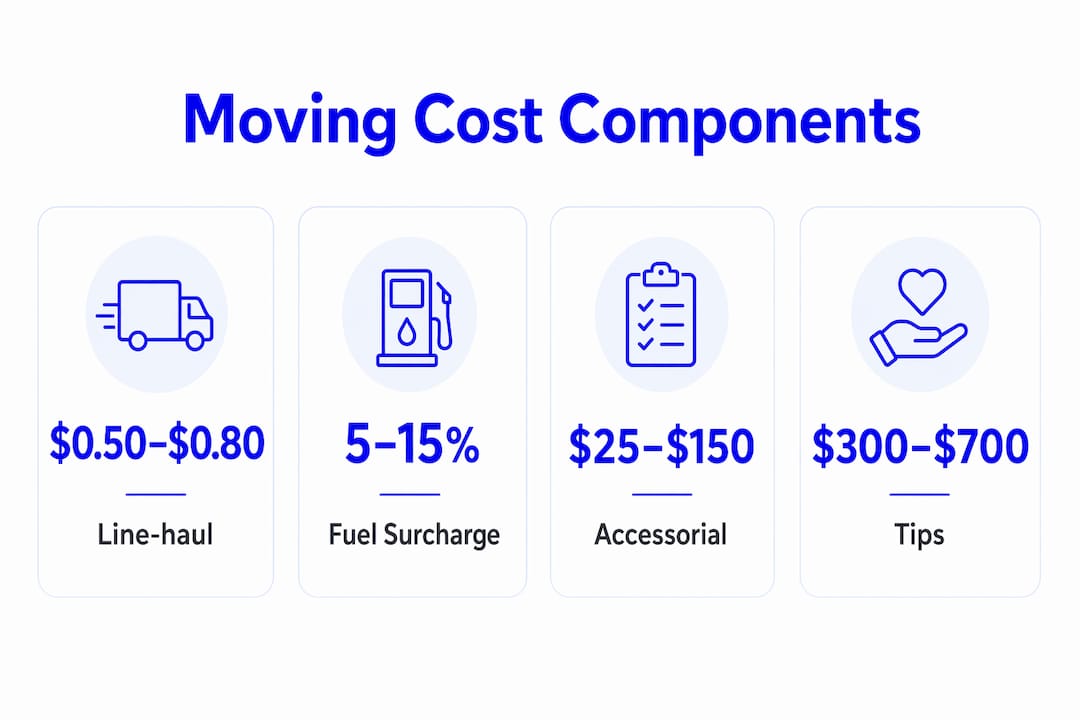
Every quote you receive breaks down into several distinct line items. Understanding each one prevents surprises on moving day.
Line-haul charge is the base cost. It is calculated by multiplying your shipment’s weight in pounds by the distance in miles, then applying the carrier’s published rate. Rates typically range $0.50–$0.80 per pound for moves up to 1,000 miles. A 5,000-pound shipment moving 800 miles could generate a base charge between $2,500 and $4,000 before any add-ons.

Fuel surcharges fluctuate with diesel prices and are applied as a percentage of the line-haul charge. Most carriers update this percentage weekly. Budget for it as a fixed cost rather than a variable, since diesel prices in Ontario rarely drop significantly during peak moving season.
Accessorial charges are where budgets most often go off track. Packing costs $25–$50 per box, stair carries run $75–$150 per flight, and shuttle service (required when a full-size truck cannot access your street) adds $300–$800. Specialty item handling for pianos, safes, or large appliances carries its own fee on top of that.
Valuation coverage is not optional if you care about your belongings. Released Value Protection is the federally required minimum, but it covers only $0.60 per pound per item. Full value protection costs about 1–3% of your declared shipment value, adding roughly $300–$500 for a standard three-bedroom move. That cost is worth it.
Tips are a real budget line. Standard tips run $300–$700 for a full crew covering both pickup and delivery, or about $50–$100 per crew member per stop.
Line Item | Typical Cost Range |
Line-haul charge | $0.50–$0.80 per pound |
Fuel surcharge | 5–15% of line-haul |
Full packing service | $25–$50 per box |
Stair carry | $75–$150 per flight |
Shuttle service | $300–$800 |
Full value protection | $300–$500 (3-bedroom) |
Crew tips | $300–$700 total |
Pro Tip: Ask every mover to itemize each accessorial charge in writing before you sign. A quote that lists only the line-haul charge is incomplete and will almost always grow.
How do distance, shipment size, and timing affect moving costs?
These three variables drive more price variation than any other factor. Getting them right in your planning saves real money.
Distance and rate per mile
Longer moves do not always cost proportionally more per mile. Carriers often reduce the per-pound rate slightly for moves over 1,500 miles because the fixed overhead is spread across more revenue. A move from Toronto to Vancouver covers roughly 4,400 kilometers (about 2,700 miles), and the per-pound rate may drop compared to a 1,000-mile move. The total bill still rises, but the rate structure rewards distance in some cases.
Shipment size and household type
Your home size is the fastest proxy for shipment weight. A studio apartment typically weighs 1,500–2,500 pounds. A three-bedroom home runs 7,000–10,000 pounds. A standard two to three-bedroom move of about 1,000 miles costs $3,500–$7,800 in 2026. Large four-bedroom households frequently exceed $10,000 before accessorial charges.
Home Size | Estimated Weight | Typical Cost (1,000 miles) |
Studio | 1,500–2,500 lbs | $1,800–$3,200 |
1-bedroom | 2,500–4,000 lbs | $2,700–$4,500 |
2–3 bedroom | 5,000–8,000 lbs | $3,500–$7,800 |
4+ bedroom | 9,000–12,000 lbs | $10,000–$15,000+ |
Timing and seasonal pricing
Peak moving months are may through august, when demand spikes and carrier capacity tightens. Moves during this window cost about 22% more than the same move in october or february. Off-peak months (october through april) consistently deliver savings of 15–25% on the same route and shipment size. For Ontario families, scheduling a move in late september or early march hits the sweet spot between weather and price.
Book at least 6–8 weeks in advance for off-peak moves to lock in lower rates.
Avoid end-of-month dates, when demand spikes regardless of season.
Mid-week pickups (Tuesday through Thursday) often carry lower rates than Friday or Monday.
Confirm your move date in writing to hold the quoted rate.
Pro Tip: If your employer or landlord gives you a flexible start date, even a two-week shift from july to september can cut your moving bill by hundreds of dollars.
How can you avoid surprise fees and get accurate moving estimates?
The single most effective protection against surprise charges is a formal inventory survey. Quotes without surveys frequently lead to bait-and-switch pricing or unexpected line-item fees added at delivery. A proper survey, done in person or by video walkthrough, gives the carrier enough detail to issue a binding or not-to-exceed estimate.
Interstate movers are required by law to provide either a binding or not-to-exceed estimate based on shipment weight and distance. Your shipment is weighed at certified scales at origin and destination. A binding estimate locks your price regardless of actual weight. A not-to-exceed estimate caps your cost at the quoted amount but allows the final bill to come in lower if the shipment weighs less.
Here is what to do before signing anything:
Request a formal inventory survey. Never accept a quote based only on square footage or a rough room count.
Get at least three written estimates. Comparing long distance moving quotes from multiple carriers reveals outliers and gives you negotiating leverage.
Verify FMCSA registration. Every interstate carrier must have a valid USDOT number. Check it at the FMCSA’s online database before signing.
Read the Bill of Lading carefully. This is your legal contract. Every charge should appear on it before your goods are loaded.
Budget a contingency. Line-item services add 20–35% to a base quote. Building that buffer into your plan from the start prevents financial stress at delivery.
Pro Tip: Ask specifically about long-carry fees, elevator fees, and storage-in-transit charges. These three items appear on more final bills than almost any other accessorial charge.
What are the cheapest long distance moving options?
Full-service movers offer the most convenience, but they are not the only way to move long distance. The cost of long distance movers varies significantly by service level, and the right choice depends on your budget, timeline, and tolerance for physical work.
The cheapest options rank in this order: DIY truck rental, portable container rental, freight trailer shipping, and full-service movers. Self-pack savings compared to full-pack services can reach $1,200–$4,250 depending on shipment size.
DIY truck rental: You rent the truck, load it, drive it, and unload it. This is the lowest-cost option but requires the most labor and carries the highest personal risk for damage.
Portable container rental: A company drops a container at your home, you load it at your own pace, and they transport it. You save on labor but still handle all packing and loading.
Freight trailer shipping: You load your goods into a shared freight trailer. Cost is low, but delivery windows are wider and handling is less careful than dedicated moving trucks.
Full-service movers: The carrier handles packing, loading, transport, and unloading. This is the most expensive option but the least stressful for families with children, pets, or complex households.
For Ontario families moving across provincial lines, full-service carriers with flat rate moving options offer the clearest pricing and the least risk of cost overruns. The trade-off in convenience is real, and for most households with significant furniture and fragile items, the price premium is justified.
Key Takeaways
Long distance moving costs are predictable when you understand the weight-and-distance tariff model, request binding estimates, and budget a 20–35% contingency above the base quote.
Point | Details |
Total cost range | Most household moves cost $5,000–$15,000 all-in, depending on size and distance. |
Biggest cost drivers | Shipment weight, mileage, service level, and season determine the final price. |
Binding estimates protect you | Always request a binding or not-to-exceed estimate backed by a formal inventory survey. |
Off-peak timing saves money | Moving october through april cuts costs by 15–25% compared to peak summer rates. |
Budget a contingency | Add 20–35% above the base quote to cover accessorial charges and tips. |
What I’ve learned from watching families budget for long distance moves
The most common mistake I see is treating the base quote as the final number. Families get a $4,500 estimate, budget $4,500, and then face a $6,200 bill at delivery because nobody asked about the stair carry, the shuttle fee, or the long-carry charge from the truck to the elevator. That gap is not fraud. It is a failure to ask the right questions upfront.
My honest advice: get three binding estimates, not three ballpark figures. There is a real difference. A ballpark figure is a carrier’s best guess before they know what you own. A binding estimate is a legal commitment based on a real inventory. The extra hour you spend doing a video walkthrough with each carrier is worth more than any discount you could negotiate afterward.
I also think people underestimate how much timing matters. Shifting a move from july to october is not always possible, but when it is, the savings are significant enough to cover a full month’s rent in many Ontario cities. That is not a minor optimization. That is a meaningful financial decision.
Finally, verify credentials before you hand over a deposit. The FMCSA database is free and takes two minutes to check. A licensed carrier with a valid USDOT number is accountable in ways that unlicensed operators simply are not. Your belongings and your budget deserve that basic protection.
— Natalie
Atlaskings offers clear pricing for your long distance move
Planning a long distance move in Ontario means dealing with a lot of unknowns. Atlaskings removes the guesswork with itemized and flat-rate pricing, so you know exactly what you are paying before the truck arrives.

Atlaskings has completed over 500 moves since 2021, and every quote starts with a thorough inventory review. No surprise fees at delivery. Their transport services cover multi-city and long-distance relocations, and their in-home delivery option handles large items with care. You can review all available services and book directly at Atlaskings for upfront, transparent pricing that fits your budget.
FAQ
What is the average cost of a long distance move?
Most households pay $5,000–$15,000 all-in for a long distance move, depending on shipment weight, distance, service level, and season. A standard two to three-bedroom move of 1,000 miles typically costs $3,500–$7,800.
How are long distance moving prices calculated?
Carriers use a weight-and-distance tariff model, multiplying your shipment’s weight in pounds by the mileage and applying a published rate. FMCSA regulations require all interstate movers to base estimates on certified scale weights.
What is a binding estimate and why does it matter?
A binding estimate is a legal commitment from the carrier to charge no more than the quoted amount, regardless of actual shipment weight. It protects you from cost overruns and is only accurate when based on a formal inventory survey.
When is the cheapest time to book a long distance move?
Moving during off-peak months, october through april, saves 15–25% compared to peak summer rates. Mid-week pickup dates and booking 6–8 weeks in advance also reduce costs.
What hidden fees should I watch for on a moving bill?
The most common surprise charges are stair carries, long-carry fees, shuttle service, elevator fees, and storage-in-transit costs. Ask each carrier to itemize every accessorial charge in writing before you sign the contract.
Recommended
Comments