

Moving Small Loads Across Canada: Your 2026 Guide


Moving small loads across Canada is defined as transporting a partial household or minimal personal items over long distances, typically under 500 lbs or less than half a standard truck’s capacity. The industry term for this is a “partial load” or “LTL” (less-than-truckload) move. Families and individuals in Ontario face a real choice: pay full-service rates designed for full households, or select a method scaled to their actual load. The right choice depends on three factors: your load size, your budget, and how much physical work you are willing to do yourself.
What are the main options for moving small loads across Canada?
Four primary methods exist for transporting small items across Canada. Each one trades cost against labor and transit time differently.
Full-service movers
Full-service movers handle every step: packing, loading, driving, and unloading. That convenience comes at a price. Full-service 2-bedroom moves cost C$7,000–12,000 coast to coast. For a partial load, you are paying for truck space you will not fill. This method makes sense only when your time is extremely limited and budget is not a concern.
Portable containers
Portable container services drop a container at your door, you load it yourself, and the company drives it to your destination. Portable containers cost 30–50% less than full-service movers for similar loads. You save money by supplying the labor. The trade-off is that loading and unloading falls entirely on you, which matters if you have heavy furniture or limited help.

Freight and LTL shipping
For very small loads, LTL (less-than-truckload) freight shipping is the most economical option. Specialized LTL freight forwarders handle loads under 500 lbs for as little as C$400–800 coast to coast for a palletized shipment. That price point is hard to beat. The catch: you must palletize your boxes yourself and drop off or pick up at a freight depot rather than your front door.
DIY truck rental
Renting a truck and driving cross-country yourself appears cheap on paper. Fuel costs alone run C$600–1,200, and you add 3–5 nights of accommodation at C$100–150 per night. That total can easily match or exceed a shared container service, without accounting for the physical toll of driving thousands of kilometers. DIY works best for moves within a single province or when you have flexible time and enjoy road trips.
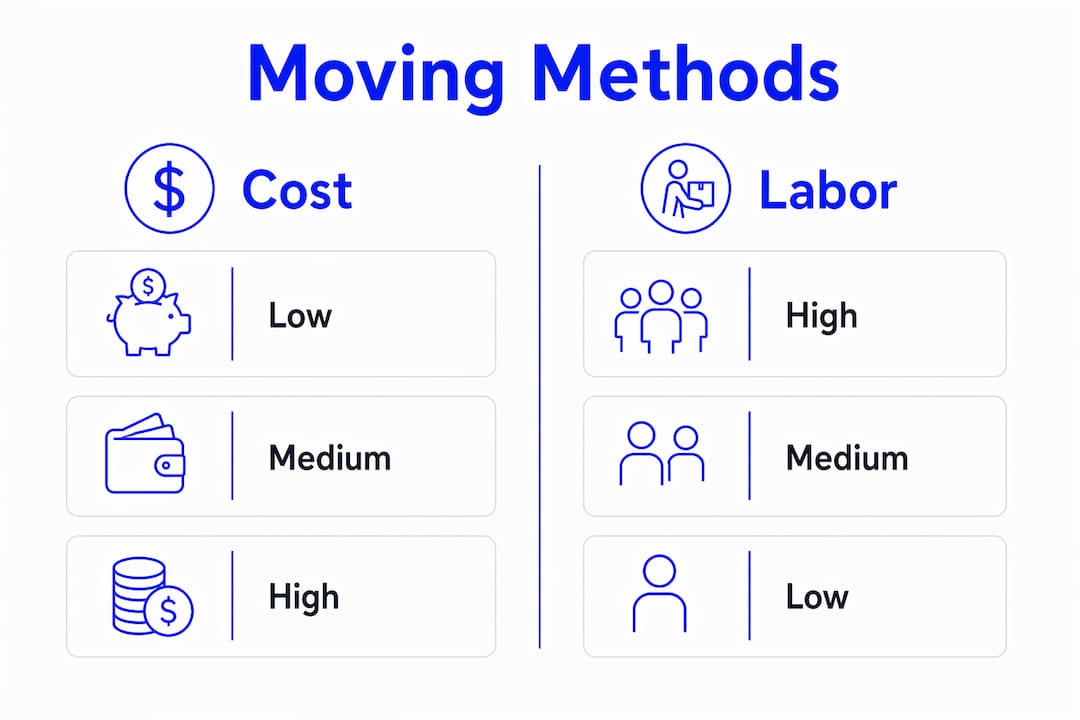
Method | Estimated cost (partial load) | Labor required | Transit time |
Full-service movers | C$7,000–12,000 | None | 5–7 days |
Portable containers | C$2,500–7,000 | Self-load/unload | 7–14 days |
LTL freight | C$400–800 | Self-palletize, depot pickup | 14–28 days |
DIY truck rental | C$1,500–3,000 (all in) | Full self-move | 5–10 days |
Pro Tip: Freight-style services are 20–40% cheaper than full-service movers for small loads. If your shipment fits on one or two pallets, get an LTL quote before calling a full-service company.
How do you assess your load size and pick the right method?
Choosing the wrong method for your load size is the most common and costly mistake in small-load moving. Getting this right before you book saves both money and frustration.
Measure your load first
The moving industry measures loads in cubic feet or by pallet count. One standard pallet holds roughly 40–50 medium-sized boxes. A typical studio apartment move fills 1–2 pallets. A one-bedroom apartment fills 2–4 pallets. Knowing your pallet count before you call any provider gives you a concrete number to quote against, rather than guessing.
Quoting based on pallets improves customer clarity and accountability far more than vague weight estimates. Providers who quote by visible space (cubic feet or pallets) give you a number you can verify. Avoid any provider who quotes only by weight without explaining how they measure it.
Downsize before you book
Moving fewer items directly reduces your cost. Before booking, sort your belongings into three categories: essential, replaceable, and unnecessary. Selling or donating replaceable items before the move often costs less than shipping them. A single large sofa, for example, can consume an entire pallet and add hundreds of dollars to an LTL quote.
Measure large furniture pieces and calculate their cubic footage.
Compare the replacement cost of each large item against its shipping cost.
Sell or donate anything where shipping costs more than replacement.
Repack remaining items into uniform medium boxes for easier palletizing.
Weigh your final load on a bathroom scale (box by box) to confirm your estimate.
Factor in your delivery location
Major cities like Toronto, Ottawa, and Vancouver have frequent LTL routes and lower freight rates. Remote or rural destinations in Northern Ontario or Atlantic Canada add surcharges and extend transit times. If your destination is outside a major urban center, a portable container or on-demand transport service may reach your door more reliably than a freight depot pickup.
Pro Tip: Book your move at least 4–6 weeks ahead during june through august. Shared container services fill up fast in peak season, and last-minute bookings cost significantly more.
How to prepare and execute a small load move across Canada
A well-organized move starts weeks before the truck arrives. Skipping preparation steps is the fastest way to damage goods or blow your budget.
Packing supplies you actually need
Double-wall cardboard boxes in small and medium sizes (large boxes overloaded with books are a leading cause of damage)
Packing tape with a dispenser, not a hand roll
Bubble wrap or packing paper for fragile items
Stretch wrap for furniture legs and drawer faces
Permanent markers for labeling every box on two sides
Step-by-step execution
Confirm your load size by measuring and weighing all items before booking.
Get three quotes from different service types: one full-service, one container or freight, and one labor-only option if you plan to self-drive.
Book your preferred method at least four weeks out, six weeks if moving in summer.
Pack systematically: heaviest items on the bottom of each box, fragile items wrapped individually, and every box labeled with contents and destination room.
Photograph all valuables before packing. This documentation supports any insurance claim if damage occurs.
Confirm pickup and delivery windows in writing with your provider 48 hours before the move date.
Common mistakes to avoid
Overpacking boxes until they bulge. A box that cannot close flat will collapse under weight in transit.
Skipping insurance on high-value items. Basic carrier liability covers only cents per pound, not replacement value.
Assuming all carriers offer door-to-door service. LTL freight almost always requires depot pickup at the destination.
Pro Tip: Rent reusable moving boxes instead of buying cardboard. Moving box rentals are sturdier, stack more uniformly on pallets, and reduce waste.
How do you handle delays, damage, and cost overruns in small-load moves?
Even well-planned moves hit problems. Knowing what to do before an issue arises keeps your move on track.
Transit times for small loads vary more than most people expect. Dedicated trucks deliver in 5–7 days, shared containers take 7–14 days, and LTL freight can run 14–28 days coast to coast. Build buffer time into your plans, especially if you have a lease start date or work deadline at your destination.
Managing transit delays
Book early in peak season. Advance booking of 4–6 weeks is the standard recommendation for shared container services in june through august. Ask your provider for a tracking number or regular status updates. Reputable carriers send text or email notifications at key transit milestones.
Protecting your goods
Basic carrier liability is not insurance. It covers a fixed amount per pound, which rarely reflects actual value. Purchase third-party moving insurance for any item worth more than C$200. For electronics, art, or jewelry, consider shipping those items separately via a courier with declared value coverage.
In-house consolidation at dedicated warehouses produces more predictable transit timelines and better shipment security than third-party consolidators. When comparing container services, ask directly whether consolidation happens in-house or through a broker. The answer tells you a lot about how much control the provider actually has over your shipment.
Cutting costs without cutting corners
Hybrid moves: ship bulky furniture via freight and carry valuables in your car.
Freight consolidation: combine your shipment with a neighbor or friend moving to the same city to share pallet space.
Off-peak timing: moving in september through april typically lowers container and freight rates compared to summer.
Flat-rate providers: flat-rate moving companies eliminate surprise charges and make budgeting straightforward.
What I’ve learned about small-load moves that most guides won’t tell you
The biggest misconception I see is that full-service moving is the only “real” option for a cross-country move. Many clients believe this until they see an LTL freight quote for C$600 versus a full-service quote for C$9,000. The gap is real, and it is not because the cheaper option is worse. It is because the cheaper option requires you to do some of the work.
The second thing most guides skip: transparent quoting matters more than the quoted price. A provider who quotes by cubic feet or pallets gives you a number you can verify with a tape measure. A provider who quotes by weight alone gives you a number you cannot check until the truck is loaded. I always tell people to ask for a space-based quote first.
Timing is underrated. Moving in october instead of july can save you 15–20% on container rates and guarantee faster booking. Most people move when their lease ends, not when rates are lowest. If you have any flexibility, use it.
Finally, combining methods works better than most people realize. Drive your car with valuables and irreplaceable items. Ship furniture and boxes via LTL or container. You get the security of personal handling for what matters most, and the cost savings of freight for what matters least.
— Natalie
Atlaskings makes small-load moving straightforward
Atlaskings has completed over 500 moves since 2021, serving families and individuals across Ontario who need reliable, fairly priced transport for smaller loads. Whether you need a single item delivered across the city or a partial household moved between cities, the team offers itemized and flat-rate pricing with no hidden fees.

The inhouse delivery service is built specifically for customers who need careful, coordinated delivery without the cost of a full moving crew. Flexible scheduling and real-time updates keep you informed at every step. For larger partial loads or multi-city moves, the small move service covers transport with the same transparent pricing. Reach out to Atlaskings to get a clear quote based on your actual load size.
Key takeaways
Choosing the right transport method for your load size is the single most important decision in a small-load move across Canada.
Point | Details |
LTL freight is the cheapest option | Loads under 500 lbs can ship coast to coast for C$400–800 via palletized LTL freight. |
Measure before you book | Quote by cubic feet or pallets, not weight, to get a number you can verify yourself. |
Book 4–6 weeks early in summer | Peak season (june–august) fills shared container slots fast; late booking costs more. |
Hybrid moves cut costs | Ship furniture via freight and carry valuables in your car to balance cost and security. |
In-house consolidation is safer | Providers who consolidate shipments in-house offer better security and more reliable timelines. |
FAQ
What counts as a small load for a cross-Canada move?
A small load is generally defined as under 500 lbs or less than half a standard moving truck’s capacity. In practical terms, this covers studio apartments, single-room moves, and partial household shipments.
How much does moving small loads across Canada cost?
Costs range from C$400–800 for palletized LTL freight to C$2,500–7,000 for portable container services. Full-service movers for similar loads run C$7,000–12,000.
How far in advance should I book a small-load move?
Book at least 4–6 weeks ahead if you are moving between june and august. Outside peak season, two to three weeks is usually sufficient for most methods.
Is LTL freight safe for household goods?
LTL freight is safe for well-packaged, palletized goods. Fragile or high-value items need extra wrapping and declared-value insurance, since basic carrier liability covers only a fixed amount per pound.
Can Atlaskings handle small loads between Ontario cities?
Yes. Atlaskings specializes in small and partial load moves with itemized pricing, making it straightforward to get a clear cost before you commit.
Recommended
Comments