

Mattress Transport Options: Your Complete Moving Guide

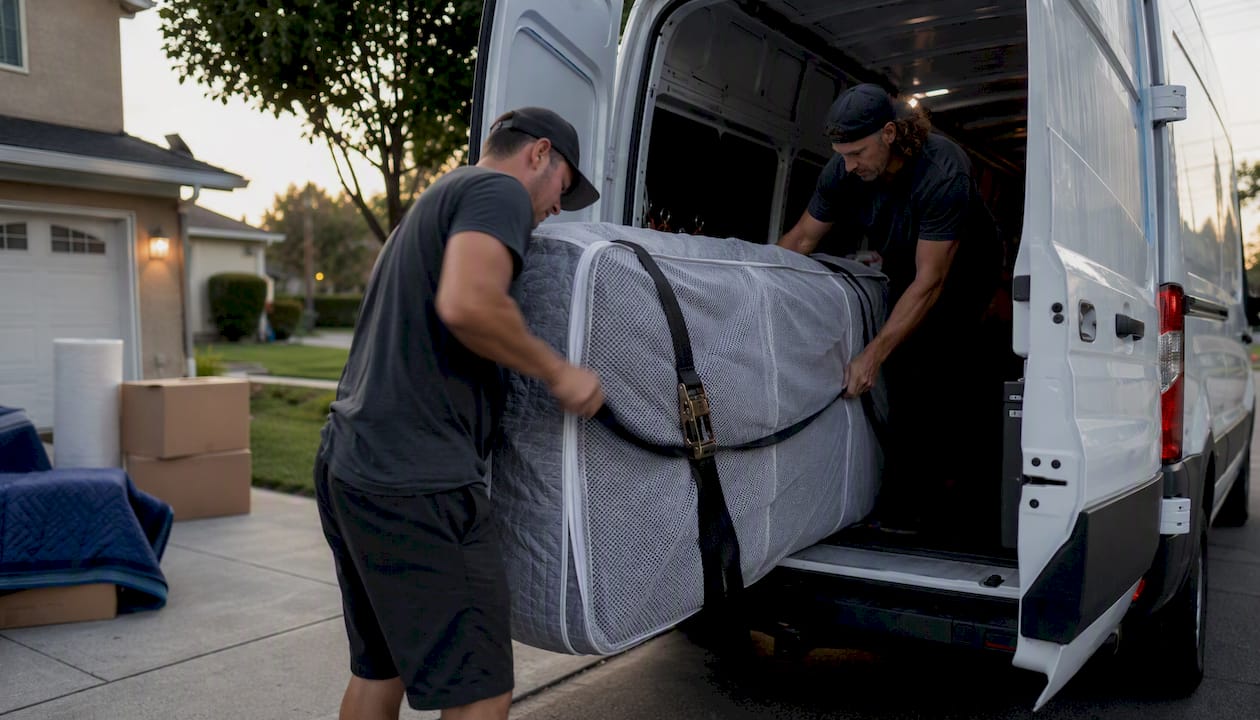
The best mattress transport options, ranked for most readers, are: an enclosed rental truck or cargo van, a pickup truck or trailer, LTL freight carriers, peer-to-peer local haulers, and vacuum-sealed parcel shipping for compressible foam mattresses. Moving pods, like PODS, are a solid choice for longer timelines. The core trade-off you’re weighing is cost versus damage risk versus physical effort.
Here’s how each option maps to your situation:
Enclosed rental truck or cargo van: Best for local moves and full household relocations; lowest damage risk for all mattress types.
Pickup truck or trailer: Works well for short local hauls when you already have the vehicle; higher exposure risk without proper securing.
LTL freight carrier: Good for cross-country single-mattress shipments; requires correct packaging and adds transit time of 2–7 business days.
Vacuum-sealed parcel shipping (UPS/FedEx): Only viable for compressible all-foam mattresses; reduces shipped volume by 60–70% and can cut shipping costs by 40–60%.
Peer-to-peer/local haulers: Budget-friendly for short distances; insurance coverage varies widely, so confirm before booking.
Moving pods (PODS): Best when you need flexible pickup and delivery timing; cross-country costs can reach $2,000–$3,600.
Key Takeaways
Choosing the right mattress transport method comes down to matching your mattress type, move distance, and budget to the option that carries the lowest damage risk for your specific situation.
Point | Details |
Match method to mattress type | Foam mattresses can be compressed; innerspring and hybrid beds must stay flat or on their side. |
Protect before you load | Use a breathable mattress bag, moving blankets, and ratchet straps on every move, regardless of distance. |
Cost vs. replacement value | Cross-country transport can cost $200–$3,600; compare that to the mattress’s replacement cost before booking freight. |
Hire pros for high-value beds | King, California king, hybrid, and warranty-covered mattresses justify professional handling to avoid damage and voided warranties. |
Atlaskings for reliable local moves | Atlaskings offers itemized and flat-rate transport and in-home delivery with over 500 completed moves since 2021. |
Table of Contents
What are your mattress transport options and when does each make sense?
How to move a mattress on a roof rack or in a pickup bed safely
What packing supplies do you need to protect a mattress during a move?
How much does mattress transport cost, and how long does it take?
When should you hire professional movers instead of doing it yourself?
How professional movers reduce damage risk: best practices that work
What are your mattress transport options and when does each make sense?
Choosing the right method depends on four things: how far you’re moving, what type of mattress you have, your budget, and how much physical work you’re willing to do. The table below gives you a fast comparison.
Option | Typical Cost Range | Physical Effort | Damage Risk | Best Mattress Types |
Enclosed rental truck/van | $30/day + mileage | Moderate | Low (flat, enclosed) | All types |
Pickup truck or trailer | up to $80/day rental | Moderate | Medium (exposure) | Innerspring, firm foam |
Roof rack (car) | — | High | High (wind, moisture) | Innerspring only, short trips |
LTL freight | $150–$360 | Low (drop-off) | Medium (handling) | Boxed/wrapped foam, innerspring |
Peer-to-peer haulers | $50–$200 | Low | Medium (varies by hauler) | All types |
Vacuum-sealed parcel | $100–$300 | Low | Low (if sealed correctly) | All-foam only |
Moving pods (PODS) | $300–$500 local; $2,000–$3,600 cross-country | Low | Low (enclosed container) | All types |
Cross-country mattress transport typically ranges from roughly $200 up to several thousand dollars depending on the method. For a low-value mattress, replacing it at the destination often costs less than shipping it across the country.
Scenario quick guide:
High-value hybrid or memory-foam bed: Professional movers or a moving pod; professionals warn that many hybrid and memory-foam mattresses must remain flat during transport to avoid internal damage.
Pro Tip: Before booking any option, measure your mattress and confirm the vehicle’s interior floor length. A California King (84 inches long) won’t fit flat in many standard cargo vans.
How to transport a mattress in a rental truck or cargo van
An enclosed truck or van is the most reliable DIY method for most people. Here’s the full sequence from prep to unload.
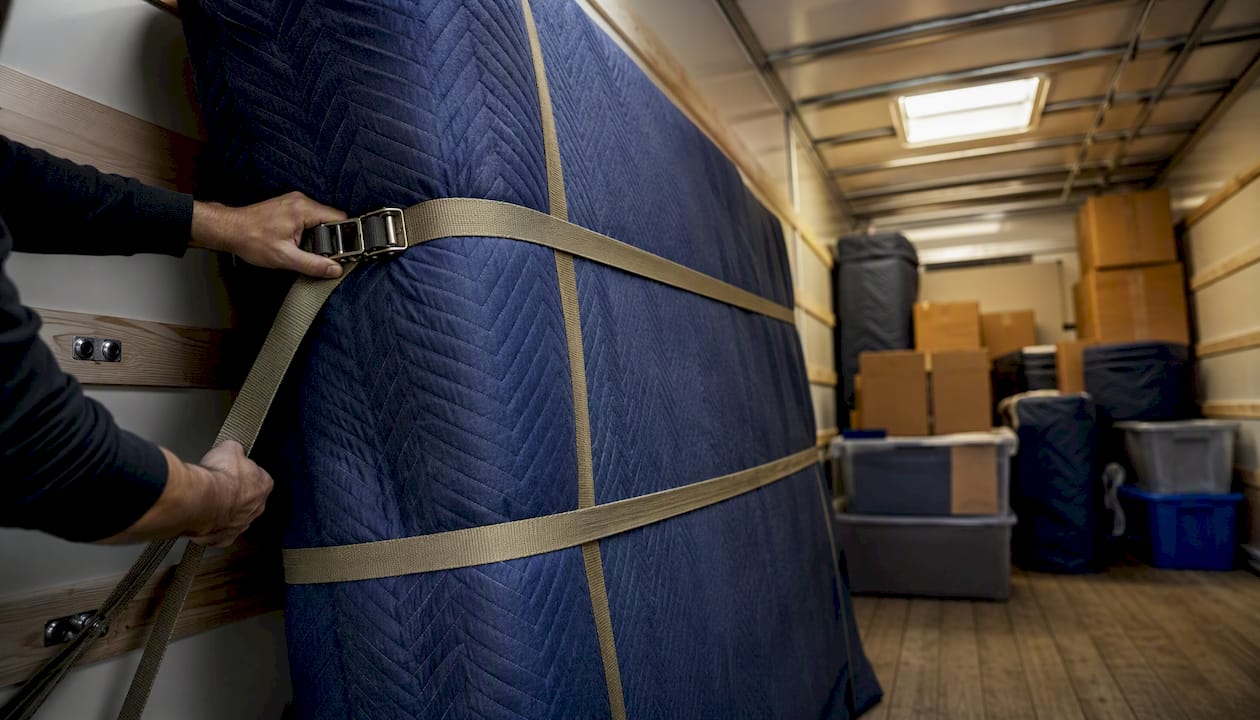
Step 1: Measure and match your vehicle
Measure your mattress length, width, and height. A standard queen mattress is 60 × 80 inches; a king is 76 × 80 inches. Confirm the truck’s interior floor length before you reserve it. U-Haul’s 10-foot truck, for example, has a cargo area of roughly 9.5 feet long, which fits most mattresses flat.
Step 2: Pack the mattress correctly
Strip all bedding and pillows from the mattress.
Slide the mattress into a breathable mattress bag with vent holes to protect against dirt, moisture, and pests. Breathable bags reduce the moisture risk that causes mold in foam mattresses.
Wrap moving blankets around the corners and edges for extra cushioning.
Tape the open end of the bag closed. For foam mattresses, avoid sealing it completely airtight unless the bag has vent holes.
Step 3: Load and secure
Use a furniture dolly to wheel the mattress to the truck ramp.
Lay foam mattresses flat on the truck floor whenever possible. For innerspring mattresses, standing them on their side against the truck’s sidewall and securing to the side rails reduces pressure on the coil system during transit.
Run ratchet straps across the mattress and anchor them to the truck’s tie-down rails. Two straps minimum: one across the upper third, one across the lower third.
Wedge furniture or boxes along the sides to prevent lateral shifting.
Step 4: Drive and unload safely
Keep highway speeds moderate. When unloading, use the ramp and dolly again. Never drag the mattress across the truck floor without the bag in place.
Pro Tip: Lift with two people whenever possible. For a king mattress, a third person at the foot of the stairs prevents the mattress from bowing and reduces injury risk significantly.
Safety note: Back injuries from mattress moves are common. Use furniture straps that distribute weight across both shoulders rather than gripping the mattress edge with your hands.
How to move a mattress on a roof rack or in a pickup bed safely
Roof transport and open pickup beds are last-resort methods. They work for short, low-speed trips but carry real risks if you skip the securing steps.
When roof or pickup transport is acceptable
Short distances only (under 10 miles, ideally under 5).
Low speeds: residential roads, not highways.
Dry weather; wet mattress bags become heavier and harder to control.
Innerspring or firm mattresses; foam mattresses absorb moisture and deform more easily when exposed.
Roof rack: step-by-step
Place the mattress flat on the roof rack or roof of the vehicle.
Run two heavy-duty ratchet straps lengthwise over the mattress, anchored through the car’s interior (open the doors and run straps through the cabin).
Add two cross straps for lateral stability.
Tape down all excess mattress-bag material and seal every open seam. Loose plastic acts as a wind sail and can tear the bag off at speed, creating a road hazard.
Have a passenger hold tension on the straps from inside the vehicle during the trip.
Pickup bed: best practices
Lay the mattress flat in the bed if dimensions allow.
Use crisscross ratchet straps, not bungee cords. Bungee cords stretch and release under wind pressure.
If the mattress overhangs the tailgate, tie the tailgate down and attach a red flag or orange ribbon to the overhang per your state’s requirements.
Drive slowly and avoid sudden braking.
Do-not list:
Do not use bungee cords as your only securing method.
Do not drive at highway speeds with a roof-mounted mattress.
Do not leave loose plastic flapping from the bag; tape it flat.
Do not attempt roof transport with a king or California king mattress; the surface area creates too much wind resistance.
Pro Tip: If you’re moving a king mattress and only have a pickup truck, rent a small enclosed trailer instead. A 5×8 trailer from U-Haul costs around $30–$50 per day and eliminates wind and weather exposure entirely.
What packing supplies do you need to protect a mattress during a move?
Getting the right gear before moving day prevents the most common damage: moisture, tears, and edge compression. Here’s what to buy and how to use each item.
Essential supply list
Breathable mattress bag with vent holes: Protects against dirt, moisture, and pests without trapping humidity inside foam layers. Pen+Gear’s universal mattress bag fits Twin through King sizes and is a low-cost option widely used for both moving and storage.
Heavy-duty mattress bag: For longer moves or roof transport, a thicker bag offers better puncture resistance. The Pratt Retail Specialties heavy-duty queen and king bag measures 100 × 94 × 10 inches and uses .0031-gauge plastic with vent holes; the open end requires tape to close since there’s no zipper.
Moving blankets: Wrap around corners and edges to cushion against wall impacts during loading.
Ratchet straps (2–4): Anchor the mattress to truck rails or roof racks. Never substitute bungee cords.
Packing tape: Seal open bag ends and tape down excess plastic on roof loads.
Cardboard sheets: Slide under a foam mattress to stiffen it during loading and prevent the mattress from folding over a ramp edge.
Shrink wrap: Useful for short-term protection during a same-day move; not recommended for long-term storage because it traps moisture.
Supply | Typical Cost | Best Use Case |
Pen+Gear universal mattress bag | Under $10 | Local moves, storage |
Pratt heavy-duty mattress bag | $15–$35 | Long moves, roof transport |
Moving blankets (set of 6) | $25–$45 | All enclosed truck moves |
Ratchet straps (2-pack) | $15–$25 | Truck rails, pickup beds, roof |
Cardboard sheets | $5–$10 | Foam mattress stiffening |
Shrink wrap roll | $10–$20 | Same-day moves, short-term wrap |
Pro Tip: Vent holes in the bag matter most for memory-foam mattresses stored for more than a few days. If you’re using a non-vented bag, leave the open end loosely taped rather than fully sealed to allow airflow.
How much does mattress transport cost, and how long does it take?
Costs vary significantly by method and distance. Here are realistic ranges to help you plan.
Option | Local Cost (under 50 miles) | Cross-Country Cost | Typical Transit Time |
Enclosed rental truck (DIY) | $30/day + fuel | $300–$600 (multi-day rental) | Same day to 3 days |
Peer-to-peer hauler | $50–$140 | $200–$320 | Same day to 2 days |
LTL freight | $150–$240 | $200–$400 | 2–7 business days |
Vacuum-sealed parcel (UPS/FedEx) | $100–$200 | $150–$280 | 3–7 business days |
Moving pod (PODS) | $300–$500 | $2,000–$3,600 | 2–7 business days |
Full-service professional movers | $200–$500 minimum | $400–$700 | 1–5 days |
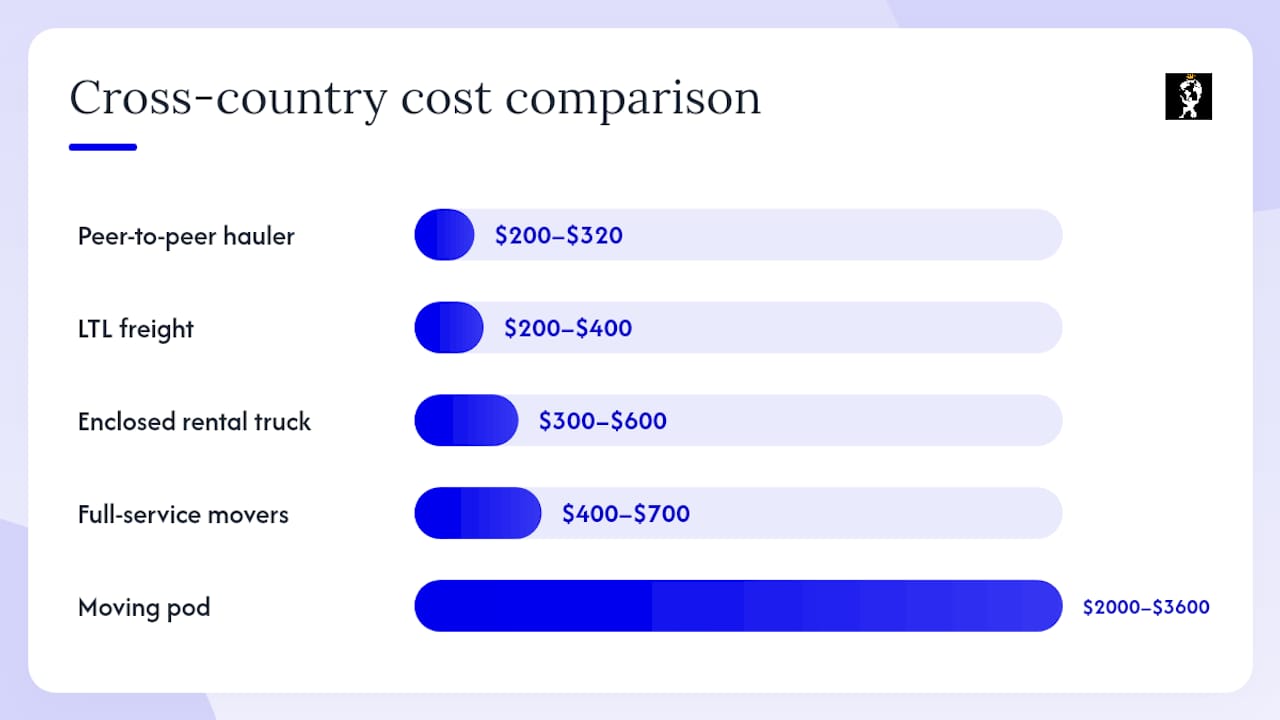
A few variables push costs higher: declared value insurance, stair-carry fees, remote delivery addresses, and same-day or weekend scheduling. For cross-country moves, it’s worth calculating the mattress’s replacement cost before committing to freight. A $300 mattress shipped cross-country for $400 is a losing trade.
Cost-saving notes:
Book rental trucks mid-week; weekend rates run higher.
Peer-to-peer platforms often come in 20–40% cheaper than traditional carriers, but confirm insurance terms before booking.
LTL freight requires correct packaging (boxing or shrink-wrapping) to avoid extra terminal handling fees; factor that supply cost in.
For large item shipping, comparing multiple freight quotes on the same day often surfaces a meaningful price difference.
When should you hire professional movers instead of doing it yourself?
Some moves genuinely call for professional help. Recognizing those situations early saves you money, time, and a damaged mattress.
Situations that justify hiring pros:
You’re moving a king or California king mattress, especially up or down multiple flights of stairs.
The mattress is new, high-value, or still under warranty.
You don’t have a second person to help with lifting and loading.
The move is long-distance and you don’t have access to a suitable vehicle.
The mattress is a hybrid or memory-foam model that must stay flat throughout transit.
Questions to ask professional movers before booking
Do you carry insurance that covers mattress damage, and what is the claims process?
Will you keep the mattress flat during transport, or do you stand it on its side?
What is your rate for a single-item mattress move, and are there minimum charges?
Do you offer shrink-wrap or mattress-bag packing as part of the service?
Is your pricing itemized or flat-rate, and what does each include?
Red flags to watch for:
The mover won’t confirm mattress orientation in writing.
Insurance language is vague (“we’ll do our best”) rather than specific.
The quote is unusually low with no itemized breakdown of services.
No mention of packing materials or handling procedures.
For readers weighing labor-only movers versus full-service, labor-only can be a cost-effective middle ground: you rent the truck, they do the heavy lifting and loading.
How professional movers reduce damage risk: best practices that work
The difference between a damaged mattress and a clean delivery usually comes down to three things: orientation, packaging, and securing.
Professional movers document the mattress condition with photos before loading. This protects both parties and creates a clear record if a damage claim is needed. They seal mattress bags completely, tape every open seam, and use ratchet straps anchored to the truck’s sidewall rails rather than relying on furniture weight alone to hold the mattress in place.
For foam mattresses, keeping the mattress flat is the standard. For innerspring beds, standing on the side against a padded wall is acceptable when floor space is limited. The key is that neither orientation is left to chance; it’s decided before loading and confirmed at the destination.
The most preventable mattress damage happens in the last 10 feet of a move: the stair carry, the doorway pivot, and the final placement. Rushing those moments is where corners get torn and foam layers get compressed unevenly. Slowing down at the end of a move costs two minutes and saves a warranty claim.
Atlaskings uses itemized and flat-rate pricing on every job, so clients know exactly what handling, packing, and transport costs before the truck arrives. Since 2021, Atlaskings has completed over 500 moves, and the consistent feedback is that transparent pricing and careful handling make the biggest difference in client satisfaction.
Pro Tip: Ask your mover to include mattress orientation (flat vs. on-side) and packing method in the written estimate. If they won’t put it in writing, that’s a signal to keep looking.
The case for slowing down before you move a mattress
Moving a mattress looks simple until it isn’t. The decisions that matter most happen before the truck arrives: confirming the mattress type, choosing the right bag, and knowing whether the bed can be compressed at all.
What most articles miss is the hidden cost of a rushed DIY move. Peer-to-peer platforms and rental trucks are genuinely good options, but they transfer all the risk to you. A torn bag, a bowed foam layer from an improper stair carry, or a coil system kinked from folding can turn a $50 savings into a $600 replacement. The math only works in your favor when the packing and securing steps are done correctly.
The other thing worth saying plainly: for a king or California king mattress, DIY is harder than it looks. The weight and dimensions of a king mattress make a two-person carry genuinely difficult in tight spaces, and the damage risk on a roof or in a pickup bed is real. If the mattress is worth protecting, the cost of a professional single-item move is usually worth it.
Atlaskings is a family-run operation that has handled hundreds of these moves since 2021. The consistent lesson from that experience is that clients who call early, before they’ve already committed to a rental truck and a friend with a bad back, end up with better outcomes and less stress.
Atlaskings makes mattress transport straightforward
Renting a truck, sourcing straps, and coordinating a second person is a lot to manage for a single mattress. Atlaskings offers a cleaner path: professional in-home delivery and transport services with itemized pricing, so you know the cost upfront with no surprises on moving day.

Whether you need a single mattress moved across town or a full small-load move under 10 large items, Atlaskings handles the packing, lifting, and placement. The team keeps foam mattresses flat, uses proper mattress bags and ratchet straps on every job, and documents condition before and after. For stair carries or tight access, the lift service is available as a standalone booking.
Atlaskings has completed over 500 moves since 2021, all with transparent flat-rate or itemized pricing. Book your mattress transport online and get a confirmed rate before your move date.
Useful sources and further reading
The following sources informed the guidance in this article. Use them to verify cost ranges, packing steps, and mattress-type rules directly.
Recommended
Comments